On this page
- Why don’t public benchmarks predict production behaviour?
- What should you actually measure?
- Can you trust an LLM to judge another LLM?
- How do you stop a prompt change from silently breaking production?
- What do you watch after the model is live?
- How do you decide how much evaluation you need?
- What does a good evaluation habit look like?
- Questions people ask
Picture a model selection meeting. Someone shares their screen, pulls up a public leaderboard, and the room nods at a table of numbers nobody can map to the product. The model at the top wins the meeting. Whether it wins in production is a different question, and nobody is assigned to answer it.
The reflex is understandable. Benchmarks are public and comparable, and building your own evaluation takes work. It’s easy to see how it goes from there: the model ships, a prompt gets “improved” on a Friday afternoon, quality drifts quietly for two weeks, and the first real evaluation happens inside a customer complaint.
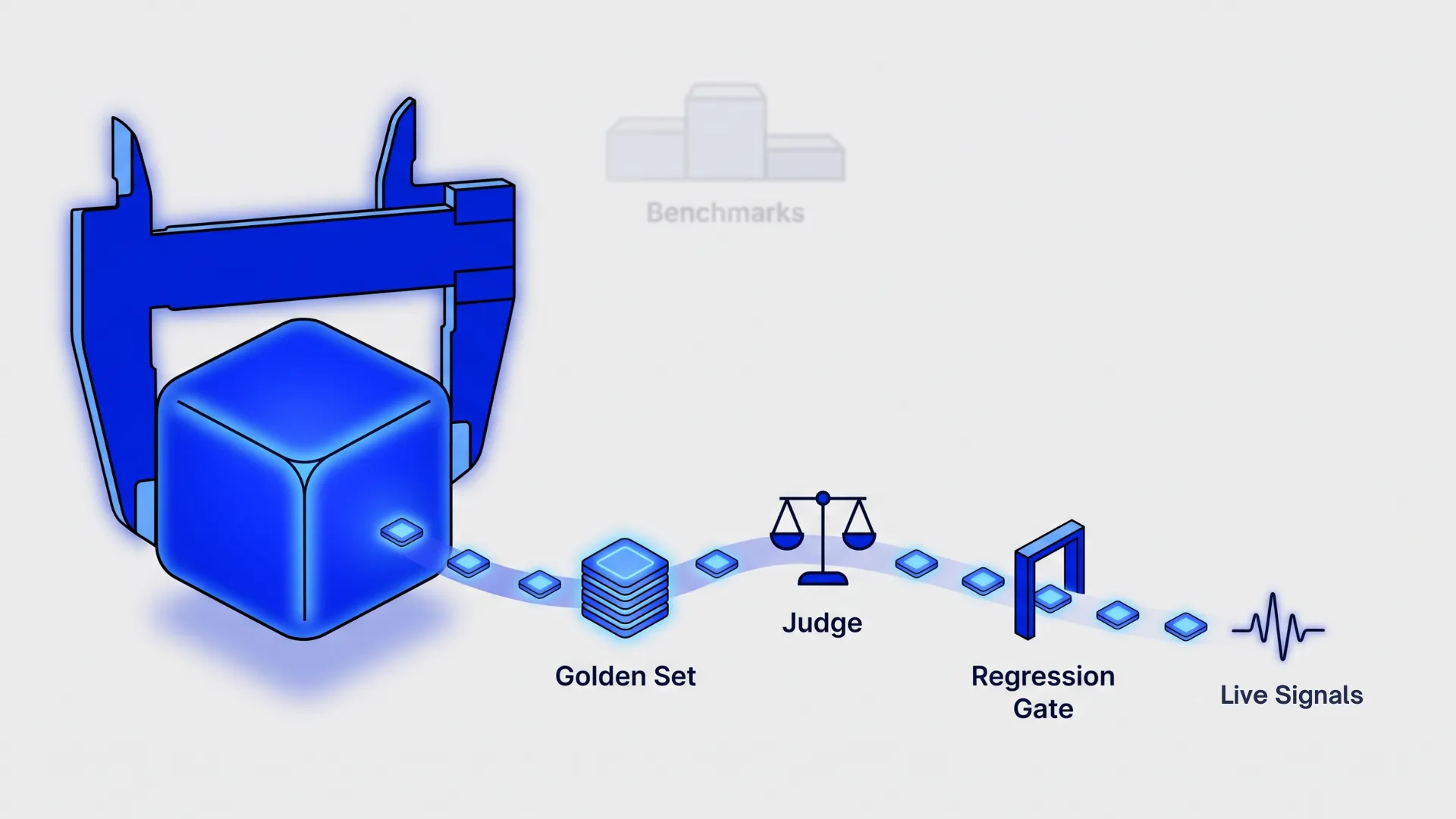
You need four things: a golden set built from your own traffic, a judging method you’ve calibrated, a gate that runs on every change, and online signals for everything the offline suite can’t see. This article walks through each one. It won’t tell you which frontier model is best, because for your specific workload that question has no general answer.
Why don’t public benchmarks predict production behaviour?
Because benchmarks measure general capability on curated academic tasks, and your product is neither general nor curated. A model’s score on a multiple-choice knowledge test places it in a capability tier. It doesn’t tell you whether the model will extract the right fields from your invoices, follow your tone guidelines, or refuse what it should refuse.
Three things break the “sort the leaderboard and pick the top” logic:
- Distribution mismatch. Benchmark questions look nothing like your traffic, and models that are close on a benchmark can be far apart on a narrow task.
- Saturation. When every serious model scores in the same band on a popular benchmark, the ranking within that band says little. The MMLU-Pro authors made this point about MMLU, noting that performance “has begun to plateau” and that scores shifted by 4–5% with prompt variations.
- Contamination. Benchmark data can leak into training sets, which a 2024 survey describes as leading to “inaccurate or unreliable performance” at evaluation time.
Would you pick a database engine off a synthetic benchmark alone, without running your own workload against it? LLMs deserve the same scepticism, arguably more, because their failure modes are quieter. Two models a couple of points apart on a leaderboard can still differ sharply on whether they follow your output schema or invent fields under pressure. No public number tells you which. A task-specific eval set will.
What should you actually measure?
Task success, defined by your product, on your own traffic. Not “model quality” in the abstract or a one-to-ten helpfulness score, but the concrete question your feature exists to answer: did the summary keep every factual claim, did the extraction match the schema, did the reply resolve the ticket.
The asset that makes this possible is a golden set: a sample of real production inputs, each paired with an agreed-correct output or a grading rubric, versioned in the repo like any other test fixture. Pull a few hundred requests from production logs, stratify them across the intents you actually see, and label them with whoever owns the product.
How many is enough is a statistics question. For a pass/fail score, the standard error is √(p(1−p)/n): at an 80% pass rate that’s about 4 points with 100 cases and 2 points with 400, a 95% interval of roughly ±8 or ±4 points. Evan Miller’s Adding Error Bars to Evals lays out this and related methods, including paired comparisons when two versions run on the same cases.
Store the results anywhere queryable. A plain Postgres table is enough, and it keeps the history honest:
CREATE TABLE eval_runs (
  run_id        uuid NOT NULL,        -- one row per case per run
  case_id       text NOT NULL,
  git_sha       text NOT NULL,        -- prompt + code version
  model_id      text NOT NULL,
  golden_set    text NOT NULL,        -- versioned dataset name
  passed        boolean,
  score         numeric(4,3) CHECK (score BETWEEN 0 AND 1),
  failure_tag   text,                 -- schema_violation, hallucination, refusal...
  created_at    timestamptz NOT NULL DEFAULT now(),
  PRIMARY KEY (run_id, case_id)
);
The failure_tag column earns its place quickly. Aggregate pass rates tell you something moved; failure tags tell you what moved, which turns an eval run into a debugging session instead of an argument.
Can you trust an LLM to judge another LLM?
Yes, within limits you’ve measured; no, if you haven’t measured them. LLM-as-judge is a scalable way to grade open-ended outputs, and it’s also an easy place in the pipeline to fool yourself. Calibrate the judge against human labels on your own data before it grades anything that matters, and design around its known biases.
Writing a “rate this answer one to ten” prompt and treating the output as ground truth produces a number with excellent uptime and unknown meaning. Instead, take a slice of your golden set that humans have already labeled, run the judge over it, and measure agreement. For reference, the MT-Bench study found GPT-4’s verdicts agreed with human preferences over 80% of the time, the same level humans reached with each other. If your judge agrees with your human labels at a rate you’d accept from a new team member doing review work, it has earned a seat. If not, fix the judging prompt before the pipeline.
Design around the known biases rather than discovering them:
- Judges can favour longer answers, even when they’re no clearer or more accurate (verbosity bias).
- In pairwise comparisons they favour one position. The MT-Bench authors’ conservative fix: judge each pair twice with the order swapped, count a win only when both orders agree, and call it a tie otherwise.
- Judges may favour their own outputs (self-enhancement bias). The MT-Bench study couldn’t confirm it either way, but a judge from a different model family is a cheap precaution when the comparison is close.
Retrieval quality has its own version of this problem, covered in why your RAG system is actually a search problem.
How do you stop a prompt change from silently breaking production?
Run the eval suite on every change, the way you run tests on every commit. A prompt edit is a deploy: it can change behaviour as much as swapping the model, and it’s easy to make with far less ceremony than a code change. Prompts belong in version control, gated in CI, with the score diff reviewed like code.
That means the CI pipeline runs the golden set against any change to prompts, retrieval configuration or model version, and posts the score diff on the pull request. And someone reads that diff: a two-point drop in overall pass rate can hide a twenty-point drop on an intent that makes up a tenth of the set, which a stratified view would surface instantly.
The gate is ordinary test tooling:
BASELINE = 0.92   # pass rate of the version currently in production
TOLERANCE = 0.01  # largest drop the gate accepts

def test_extraction_suite(golden_set, model_under_test):
    results = run_eval(golden_set, model_under_test)  # your eval harness
    assert results.pass_rate >= BASELINE - TOLERANCE
    # fail loudly on any regression in critical tags
    assert results.failures_by_tag.get("schema_violation", 0) == 0
If this looks like the discipline database teams apply to schema migrations, that’s the point (see zero-downtime database migrations). Migrations are safe not because of a clever tool but because nobody ships unreviewed structural change. Prompts deserve the same refusal. For bigger changes, model swaps especially, add a shadow phase: run the candidate on a copy of live traffic, compare its outputs with the incumbent offline, and only then route real users.
Isn’t this expensive? Usually less than it looks. At about a cent a call, the illustrative rate worked through in the real cost of an LLM call, a 400-case run costs about $4, plus the judge’s calls on the cases that need one. Run the cheap mechanical checks on every commit and reserve judge-graded runs for merges.
What do you watch after the model is live?
The signals users generate when the model fails them. Offline evals grade the failures you imagined; production supplies the ones you didn’t, and users signal them through behaviour, not only through the feedback button. Retries, escalations and heavy edits are cheap quality signals you can mine from logs you already keep.
The high-value signals are behavioural:
- Immediate retries and rephrasings of the same question suggest the first answer missed.
- Escalations to a human right after a model interaction suggest the task wasn’t resolved.
- Heavy user edits to a generated draft are a direct quality measurement.
- On the system side, schema validation failures, tool-call errors, truncated outputs and refusal rates are cheap to count and hard to argue with.
Explicit thumbs ratings, by contrast, come only from users who choose to leave them, so they’re a self-selected sample. Treat them as a weak signal, not a metric to optimise.
Segment these signals, too. An aggregate retry rate can look flat for weeks while one intent quietly fails, because a small intent barely moves the average. Break retry rate out by intent and the failing one stands out. If the golden set holds three examples of that intent and production holds thousands, that gap explains why no eval run caught it.
That gap is why you need the flywheel: every production failure you catch is a labeled example you didn’t have to invent. Route flagged interactions into a review queue, label a sample each week, and fold confirmed failures into the golden set. Over time, your eval suite comes to describe your actual failure surface instead of your launch-week guesses.
How do you decide how much evaluation you need?
Four questions turn all of this into a plan: can outputs be checked mechanically, do you have real traffic yet, how expensive is a bad output, and how often do prompts and models change. Mostly mechanical, real traffic, low stakes and frequent changes means a lean, almost fully automated pipeline.
- Can the output be checked mechanically? Schema validation, exact match and code execution are cheap, deterministic graders. Push as much of the eval surface as possible into this tier before reaching for a judge model.
- Do you have real traffic yet? If not, write synthetic cases from the spec and treat them as placeholders, to be replaced by sampled production data within the first weeks after launch. A golden set built entirely from imagination measures your imagination.
- How expensive is a bad output? This sets the floor for human involvement. Low-stakes drafting can live on automated judges and behavioural signals. Anything touching money, health or legal exposure keeps a permanent human sampling loop.
- How often do prompts and models change? A prompt that changes weekly needs a fully automated CI gate. A model reviewed quarterly can afford a heavier, partly manual bake-off.
The further your answers drift toward open-ended, synthetic, high-stakes and infrequent, the more human judgment stays in the loop.
What does a good evaluation habit look like?
Unexciting: a golden set sampled from your own traffic, mechanical checks wherever possible, a calibrated judge for the rest, a CI gate on every prompt and model change, and a weekly loop that turns production failures into new eval cases. None of it requires a platform purchase or a research team to run.
Most of it is the testing discipline your team already applies to ordinary code, aimed at a component that happens to be probabilistic. The cautionary version is just as plain. Teams that skip it pick models off leaderboards, edit prompts in dashboards, and find out about regressions from customers. By the time the complaint arrives, nobody can say which of the recent prompt tweaks caused it.
So resist the pull of someone else’s numbers. Sample your traffic, label it, gate your changes, and let production teach your eval suite what failure looks like.
The AI section of crafted.data covers the rest of running models in production, starting with fine-tuning vs RAG vs prompting.
Key takeaways
- Public benchmarks sort models into rough capability tiers. They don't measure your task, and your production traffic is a different distribution from any benchmark.
- The highest-value evaluation asset you can own is a golden set: a few hundred real production inputs with agreed-correct outputs, versioned like code.
- LLM-as-judge is usable, but only after you've measured its agreement with human labels on your own data.
- Treat every prompt or model change like a database migration: nothing ships without the eval suite passing, and someone reviews the score diff.
- Offline evals catch regressions you anticipated. Online signals such as retries, escalations and malformed outputs catch the failures your golden set never imagined.

Questions people ask
What is a golden dataset for LLM evaluation?
A versioned collection of real production inputs paired with agreed-correct outputs or grading rubrics. Teams run it against every prompt or model change to catch regressions before deployment. Sampling from live traffic matters more than size, because examples written from a spec only measure what you imagined users would ask.
How many examples do you need to evaluate an LLM in production?
Enough for the differences you care about to stand out from noise. For a pass/fail metric near 80%, the standard error is about 4 points with 100 examples and 2 points with 400, so a few hundred cases, stratified across real intents, can detect drops of several points. Labeling quality matters as much as count.
Is LLM-as-a-judge reliable?
It can be, after calibration. In the MT-Bench study, GPT-4 as a judge agreed with human preferences over 80% of the time, about the rate humans agree with each other. Judges also show position and verbosity biases, so measure agreement on your own labeled data and swap answer order in pairwise comparisons.
How often should you re-run LLM evals?
Run the offline suite on every prompt, model or retrieval change, exactly like a test suite in continuous integration. Separately, refresh the golden set itself on a regular cadence, with monthly as a reasonable starting point, and after any major product change.
Do public benchmarks like MMLU still matter?
For shortlisting. Benchmarks sort models into rough capability tiers and help rule out options that are clearly too weak or too expensive. Within a tier they say little about your specific task, and scores on popular benchmarks like MMLU have begun to plateau, so a golden set from your own traffic takes over.

Cloud, DevOps and Database Engineer. I write crafted.data so the next person can skip the painful part.
Get the next article by email
One email when a new deep-dive is out: databases, cloud and AI, with the code. Unsubscribe in one click.
Email signups open soon. Until then, new articles are announced on Instagram.